


Hard disk drives (HDDs) still form the backbone of the data storage industry in 2026. The AI boom and surging SSD prices mean hard drive lifespan remains a concern for businesses and consumers.
We last outlined some research on how long hard drives last in 2023. The article presented our findings on the real-world failure rates of hard drives. We collected data from a sample of over 2,000 disks delivered to our labs in 2022. That batch of hard drives failed after an average of 1,051 days. Or roughly 2 years and 10 months.
So, we decided to ask:
How long do hard drives last in 2026?
For this update, we increased our sample to over 5,000 failed hard drives between early 2023 and mid 2026.
Here is what we found.
Summary:
- The median hard drive failed at 362 days. The average hard drive lasted 807 days.
- The average hard drive lifespan in our 2026 sample was 23.2% shorter than the disks in the 2023 study.
- The gap between the median and the average indicates a significant number of early failures. 49.8% of the disks failed within their first 8,760 hours (365 days) of operation.
- 30.5% of HDDs failed with a current pending sector count of zero.
Measuring How Long Hard Drives Last
Let’s start with the basics.
There are three methods to measure how long hard drives last. Each method uses a different approach to pinpoint a hard drive’s lifespan. Their relevance depends on the audience and objectives.
Hard Drive Reliability Metrics
Mean time between failure (MTBF) is an estimate of the expected lifespan for a group of disks under ideal conditions. Most storage companies list the MTBF for their devices in a datasheet. The figure applies to the entire population of a product line. It is important to note that this metric (often expressed in hours) is based on accelerated testing in a controlled environment.
Therefore, MTBF does not truly reflect the lifespan of a hard drive in real-world situations. Heavy, sustained workloads will wear out the components inside a hard drive faster than the theoretical lifespan.
An annualized failure rate (AFR) is the percentage of disks in a group that failed within a year. Cloud storage platform Backblaze uses AFR to track the reliability of hard drives in its data centers. Their quarterly Drive Stats reports contain hundreds of thousands of disks and compare failure rates across dozens of different enterprise models.
As a result, AFR excels at revealing patterns from observed failures across large HDD samples. It helps guide large-scale deployments and replacement strategies.
Real-World Hard Drive Failure
SMART (Self-Monitoring, Analysis, and Reporting Technology) is a built-in tool that detects hardware issues. It records values on a reserved portion of the platters and reports them through software on the host system. These attributes can diagnose failure or warn of future issues.
Reviewing SMART values from a failed HDD can provide insights into individual failures.
What Is the Average Lifespan of a Hard Drive?
The study uses SMART attributes to measure how long hard drives last in the real world. We analyzed values for SMART 9 (power-on hours) and SMART 197 (current pending sector count) at the moment of failure.
Unlike MTBF and AFR, this data is a direct record of a specific hard drive that failed in the field. The sample also offers a glimpse into the condition of the platter surface leading up to the hard drive’s failure.
Our Sample
This analysis followed a similar process as the prior edition. However, we slightly increased the sample size.
Our engineers collected data from 5,106 hard drives. The vast majority of devices were produced by four major manufacturers. The rest of the sample included Samsung, Maxtor, and lesser-known brands. There was a mix of legacy hard drives and modern models. In addition, this sample consisted of only single drives. No members of disk arrays were analyzed.
Each disk was sent to us for professional data recovery services. They arrived in our labs between early 2023 and mid 2026. All HDDs in the sample were diagnosed with mechanical failure or physical damage.
These failures included:
- Failed read/write heads
- Burnt or defective printed circuit board (PCB)
- Damaged firmware and Service Area (SA)
Editor’s Note: Hard drives with logical issues were excluded. Accidental deletion or formatting, and some cases of file corruption, are caused by human error rather than hardware failure.
We also removed another group of hard drives. Sometimes, platter damage causes drives to report unreliable values. We treated those disks as outliers and excluded them from the final results. For example, hard drives cannot record 3.4 million power-on hours (more than 388 years) because they were invented in 1956. Likewise, HDDs cannot register -412 million power-on hours.
Our Findings
Ultimately, we found that the median hard drive in our sample failed at 8,687 hours (362 days). If the median device started running at midnight on January 1st, it would fail on December 28th of the same year.
Yet, the average values paint a different picture. The same disks lasted an average of 19,375 hours (807 days). That total equates to about 2 years, 2 months, and 17 days of use. While more than double the median, this figure is still 23.2% shorter than our 2023 average.
This data reveals that a few long-spinning HDDs skewed the average higher. In fact, 49.8% of the hard drives failed in fewer than 8,760 power-on hours (365 days).
This variation makes the average riskier for long-term planning and overstates how much time users have to prepare.
The following table shows the manufacturer-level data for median power-on hours and current pending sector count:
Here is the data for average power-on hours and current pending sector count in the cohort:
Breaking it down further:
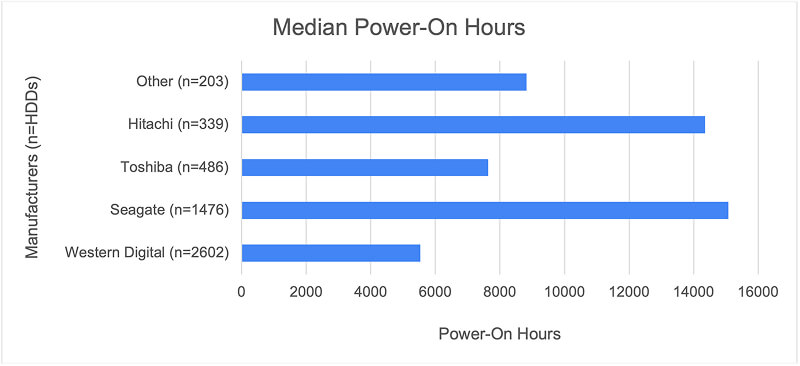
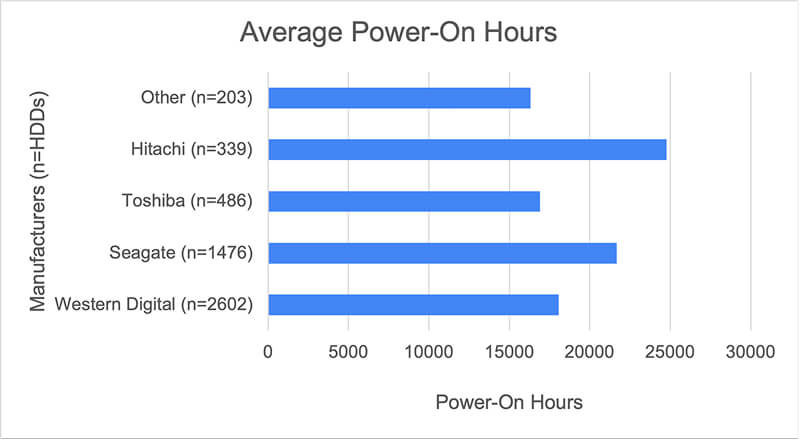
Power-on hours show how many hours a drive operated before failure. This metric helps frame other factors in a failed device, such as usage habits.
As you can see, there is a substantial gap between the median and average power-on values. The discrepancy illustrates that many hard drives failed early, but the surviving disks skewed the mean to the right.
Take a look at the distribution of failures.
| Hard Drive Failure Breakdown | |||
|---|---|---|---|
| Year of Operation | Hours From | Hours To | Failed Drives |
| Year 1 | 0 | 8,759 | 2,543 |
| Year 2 | 8,760 | 17,519 | 676 |
| Year 3 | 17,520 | 26,279 | 498 |
| Year 4 | 26,280 | 35,039 | 381 |
| Year 5 | 35,040 | 43,799 | 242 |
| Year 6 | 43,800 | 52,559 | 210 |
| Year 7 | 52,660 | 61,319 | 166 |
| Year 8 | 61,320 | 70,079 | 125 |
| Year 9 | 70,080 | 78,839 | 73 |
| Year 10+ | 78,840 | 154,539 | 192 |
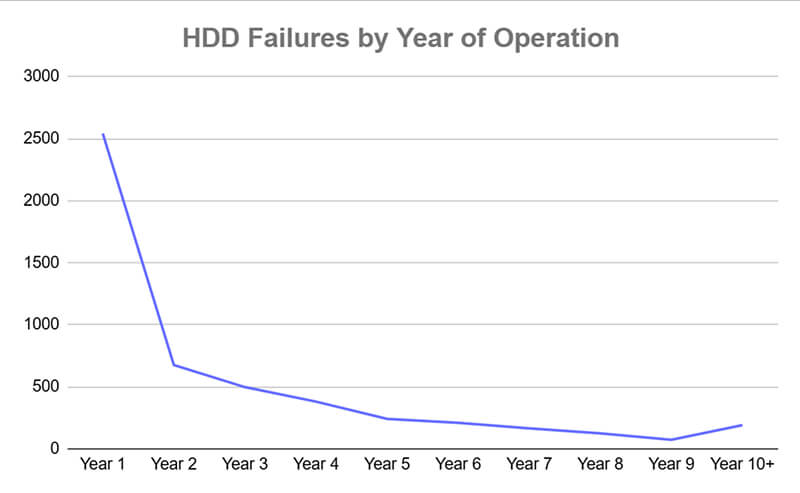
The line graph shows when the hard drives failed. Its shape tells a couple of stories about HDD failure. The sharp drop shows a significant amount of early-life failures. These failures are characterized by defective components from production and unpredictable events, such as accidental drops or power surges.
The gradual thinning of the tail indicates fewer failures are observed among surviving units still in use. Many of the hard drives in this section encountered random failures. The rise at the end of the line reflects a disk’s inevitable failure from wear and tear.
Kudos to the 320 GB Western Digital Caviar Blue HDD that lasted for 154,539 hours (over 17 years).
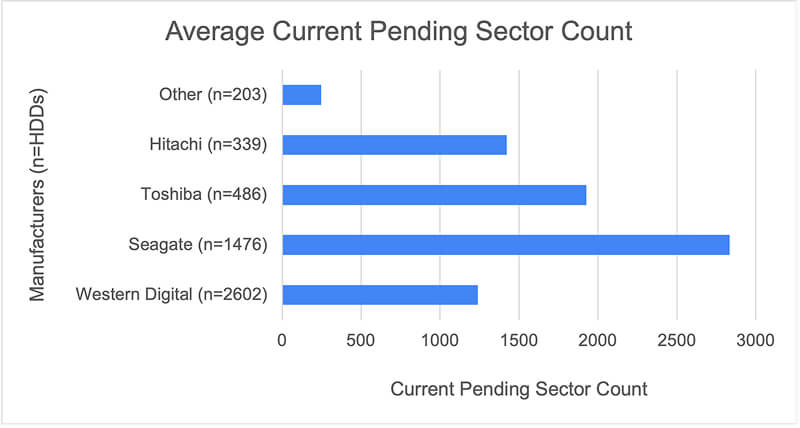
The current pending sector count denotes the number of unstable sectors that developed on the disk during that time. Higher values can indicate an imminent problem with the drive. While these sums are a fraction of the total sectors, the rate of reallocation and the risk of file corruption often increase quickly.
Hard drives from WD, Seagate, and Toshiba had higher current pending sector counts than their prior numbers. Hitachi fared better than its previous average. Overall, the average current pending sector count was 12.4% higher than the 2023 sample despite shorter lifespans.
Interestingly, 30.5% of hard drives in the sample had zero current pending sectors. That means these damaged disks failed without receiving a SMART warning from their PC.
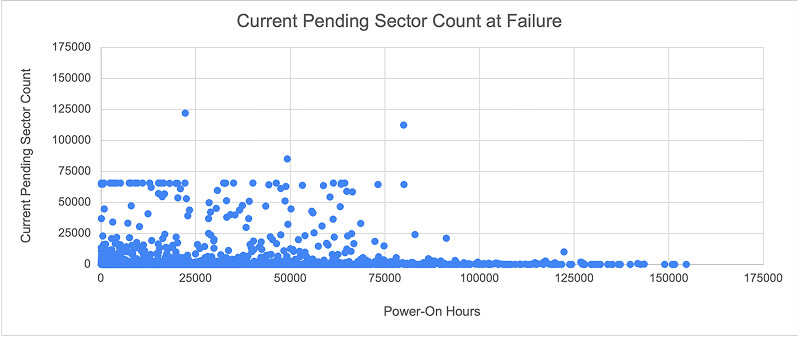
The plot shows the relationship between power-on hours and current pending sector count. It reveals how hard drive platters trend as the disk ages.
There is higher variance in pending sector counts at lower power-on hours. As usage increases, the pending sector counts at failure clusters closer to zero. It suggests that current pending sector count alone is not strongly predictive of a hard drive’s lifespan.
Cost of Hard Drive Failure
The cost of hard drive failure goes beyond buying a replacement disk. Users must consider the impact of downtime and the cost of data recovery services to restore lost files. It still takes time to implement working backups. A failed hard drive could translate to a missed deadline for a crucial project or lost sales for a business.
Thus, routine hard drive maintenance is vital.
Best Practices for Hard Drive Maintenance
These six expert tips can help hard drives last longer:
- Monitor SMART attributes for warning signs like pending sectors and uncorrectable errors.
- Maintain ideal conditions by limiting extreme heat, vibrations, and shocks.
- Keep drivers up to date to address potential conflicts or issues.
- Use an uninterruptible power supply (UPS) to prevent dangerous surges.
- Avoid aggressive spin-up and spin-down cycles that strain components.
- Defragment the device at regular intervals to reduce the actuator arm’s required movement.
Yet, accidents can still happen despite your best efforts. That means a backup strategy is essential. The 3-2-1 Rule is a proven backup method and protects data in the event of hard drive failure.
Key Takeaways on Hard Drive Lifespan
Here’s what we found based on an analysis of SMART values from 5,106 failed HDDs:
- The median hard drive failed at 362 days, while the average was 807. The dramatic difference indicates that many of our disks failed much quicker than most users would expect.
- Failure risk was not constant over the hard drive’s span. For example, 49.8% of HDDs did not survive their first year of operation.
- 30.5% of hard drives failed with a current pending sector count of zero. Degraded media is a concern, but disks can fail at any time due to damaged read/write heads, fried PCBs, or firmware corruption.
- SMART values reveal that real-world failure looks quite different from MTBF and AFR figures. Instead of fleet-wide metrics, SMART captures drive-specific data for the device that matters most to you.
- Western Digital, Seagate, and Toshiba recorded lower power-on hours and higher current pending sector counts than in our 2023 study. Hitachi, which WD acquired in 2012 and then discontinued in 2018, fared better.
These findings reflect data in a sample of failed hard drives sent to a lab for professional data recovery. As a result, they contain a higher number of early-life failures than the total population. Failures include drops, electrical issues, extreme heat, or production defects, such as sector errors, head misalignment, or a seized spindle motor.
Therefore, these findings are descriptive rather than prescriptive for a particular disk. Multiple variables will determine the lifespan of your hard drive.
However, we feel the incidents add insight into real-world hard drive failure and work in tandem with MTBF and AFR numbers.
Secure Data Recovery is a worldwide leader in hard drive recovery services. Since 2007, our certified engineers have retrieved billions of files across more than 100,000 cases. We have experience and expertise with all storage devices, failure types, and file systems. Our services feature a 96% success rate, free quotes, and a No Data, No Recovery Fee guarantee.
Frequently Asked Questions
How long do hard drives typically last?
A specific hard drive’s lifespan is influenced by numerous factors. The median hard drive in this exercise lasted 362 days. The average lifespan of a hard drive in our sample was 807 days. Having said that, various metrics will offer different snapshots of hard drive failure.
What is the best metric to measure hard drive failure?
It depends on the context. Mean time between failure (MTBF) is a theoretical benchmark for new hard drives. Annualized failure rate (AFR) is a practical metric for observed failures within a large population of HDDs. SMART is a reporting system that explains specific failures. Considering each method provides the most complete picture of hard drive failure.
What is the bathtub curve of hard drive failure?
The bathtub curve describes the shape of a hard drive’s failure rate on a graph. The graph begins with a high failure rate, which then falls quickly. In our study, 49.8% of HDDs failed within the first 365 days. After the early failures, the curve flattens out for an extended period. Finally, it spikes again as hard drives reach the end of their life and experience mechanical wear.
Is a high current pending sector count a sign of failure?
It is a sign of failure, but not entirely predictive. A high current pending sector count indicates the hard drive struggles to remap the platter surface and read data. A rapidly increasing value is one of the strongest indicators of a failing hard drive. Even so, disks can still fail with zero pending sectors, as seen with 30.5% of HDDs in this study.
Can a hard drive fail with little or no warning?
Yes. A hard drive can fail without warning for several reasons. Failure modes such as head crashes, faulty PCBs, and firmware corruption often occur abruptly. They can even occur before you expect them. Our findings show that 49.8% of hard drives failed within their first year. This reality makes maintaining working backups of important data essential.
What are some warning signs a hard drive is failing?
Common signs of hard drive failure include:
- Hard drive clicking, grinding, or beeping
- Hard drive not showing up on PC
- Slower read/write speeds
- Computer keeps freezing
- Corrupted files
Shut down the device as soon as possible if you notice any of these symptoms. Continuing to run the hard drive could cause further damage and complicate data recovery efforts.

Timothy Burlee

Timothy Burlee is a content writer for Secure Data Recovery Services. He specializes in various topics in the data industry, including data recovery technology, storage devices, and digital forensics. Throughout his career, he has covered complex concepts and provided accessible solutions for users. Before joining Secure Data, he worked as a freelance technical writer.




.png)
