


Dual-actuator hard drives offer high performance in enterprise environments, but their increased throughput comes with a notable tradeoff. The unique architecture of these advanced hard disk drives (HDDs) presents a data recovery challenge when something goes wrong.
Retrieving data from a multi-actuator drive requires knowledge of how the technology works and what happens after a hardware failure.
What To Know:
- A failed read/write head on either assembly causes data loss isolated to that actuator’s zone. These partial failures create a situation that standard tools cannot resolve.
- Specialty firmware controls both actuators in the disk. Recovery systems do not recognize the drive’s microcode.
- The compact design and scarcity of donor parts mean there is a narrow margin of error. A skilled technician could be the difference between permanent data loss and file recovery.
What Is a Dual-Actuator Hard Drive?
A dual-actuator drive is a disk that stores data on magnetic platters with two head stack assemblies in a single enclosure.
The device features two independent actuator arms to improve performance by reading and writing data in parallel. This advantage of dual-actuator HDDs makes them a strong choice for more demanding platforms, such as workstations and data centers. These drives often form massive storage pools of warm and cold data for AI tasks.
Seagate incorporates its MACH.2 multi-actuator technology in the Exos product line of enterprise hard drives. Western Digital has deployed dual actuators in some Ultrastar models.
Obstacles in Recovering Data From Multi-Actuator HDDs
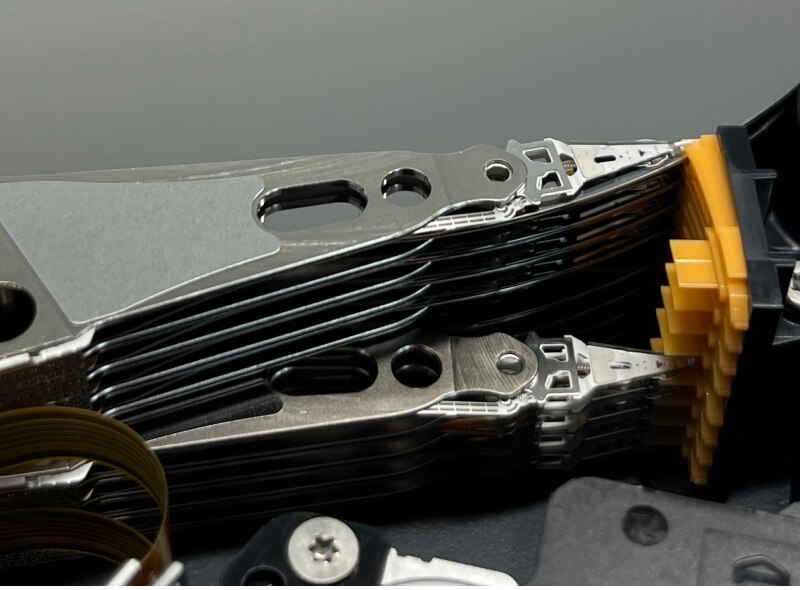
It can be difficult to recover data from a hard drive under normal circumstances. Restoring data on a multi-actuator drive poses additional challenges to engineers.
As a result, these cases frequently have more of an R&D workflow than a routine procedure.
The following concepts and constraints are the biggest obstacles to hard drive recovery on a device with two actuators.
Separate Logical Units
Dual actuators allow manufacturers to split the disk into separate logical units for more responsive hard drives with higher read/write speeds.
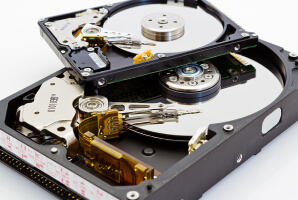
One actuator arm positions read/write heads for a group of platters within the enclosure. The other actuator carries a second head stack assembly (HSA) over the drive’s remaining platters. Each set of read/write heads is only responsible for data in its specified actuator zone.
The design enables the system to request and receive data from two zones concurrently, reducing latency when in use.
However, a data recovery professional must account for how files are spread across the platter surface when these HDDs fail. The logical division adds a layer of complexity beyond a conventional hard drive.
Complex Firmware
Because each drive contains dual actuators and two logical units, the device needs specialized firmware to manage data.
Firmware controls the positioning of both head stack assemblies to ensure the actuators work in tandem. This microcode is more sophisticated than the firmware for a hard drive with a single actuator. Standard software cannot interpret the state of a dual-actuator drive.
Damaged firmware results in data loss for both actuator zones, even if all components are intact.

Therefore, an engineer first needs to establish reliable communication with the hardware in order to extract data. If not, the dual stream of inputs and outputs could corrupt data in the other region.
Synchronized Imaging
Imaging is the process of creating a bit-by-bit copy of a storage device to preserve its original data.
In most cases, the imaging process proceeds in a linear sequence across the entire hard drive. That method is not possible for a disk with multiple actuators, which distributes data across a pair of exclusive zones.
Without an image, data stored on the domains is vulnerable during the recovery.
Shared PCB
Despite the split architecture of these HDDs, the separate logical units share a printed circuit board (PCB).
The PCB delivers power to the drive’s components and coordinates signals for both head stack assemblies at the same time. For that reason, the PCB is a single point of failure for dual-actuator drives.
Board-level repairs on a multi-actuator disk are more involved than on a traditional hard drive. Read-only memory (ROM) chips on the PCB store a unique set of adaptive data tied to each head. This data calibrates their read and write performance for a specific model, revision, and zone.
As such, sourcing compatible components for the drive is essential.
Limited Donor Parts
Donor parts are used to replace failed components and restore function long enough to recover lost data from the device.
For starters, dual-actuator drives comprise a small fraction of the total HDD market. In addition, these disks have strict requirements beyond the exact model. All donor parts must also match the firmware revision and actuator parameters.
A mismatch in values can prevent the failed drive from spinning up its platters.
Physical Constraints
Disks with dual actuators are also helium drives, which introduces another challenge in these cases. The enclosures are filled with helium gas rather than regular air, then sealed to reduce friction and turbulence.
Helium drives have a controlled atmosphere to ensure smooth operation under a sustained workload. Their compact design demands precision tools for invasive procedures that address mechanical failure or repair physical damage.
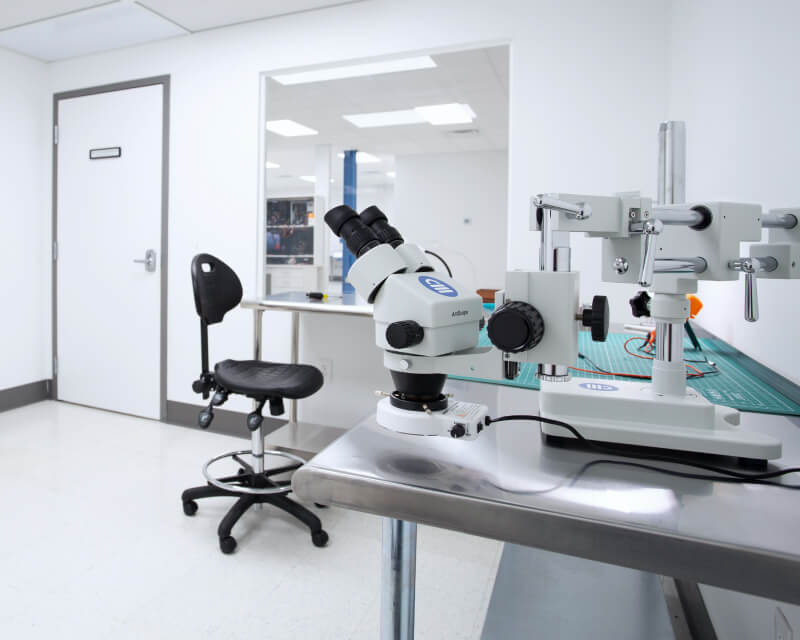
You also need a state-of-the-art cleanroom to protect platters against harmful particles, such as dust or debris.
These constraints make it even harder to recover data from a multi-actuator hard drive.
Enterprise Data Recovery for Failed Hard Drives
Secure Data Recovery has restored critical documents and projects on enterprise hard drives since 2007.
We provide data recovery services for all types of hard drives, including disks with multi-actuator technology. Our standard service features free diagnostics, no-risk quotes, and a No Data, No Recovery Fee guarantee.
These cases take considerable skill, research, time investment, and particular donor parts to resolve. The cost of these jobs reflects the amount of resources required to recover data from a multi-actuator drive.
Call 800-388-1266 or get a free quote online to start a case and quickly regain access to your data.
Frequently Asked Questions
Is it worth paying for data recovery for a multi-actuator HDD?
Yes, if you lost important data and do not have a working backup. A professional data recovery service is your best option to restore files on a failed HDD with multi-actuator technology. Data recovery software cannot read these drives, rebuild them after logical errors, or repair physical damage. A DIY approach raises the risk of further data loss.
Our staff will explain our flexible service options, so you can find a plan tailored to your needs.
Can a data recovery service only retrieve files from one actuator zone?
It depends on the failure scenario. If a head crash in one zone causes severe platter damage, then data in the other domain might be intact. An engineer could recover data from the unaffected area of the hard drive. Files spanning both zones may be lost without a complete image of the device.
We offer a free evaluation of the hard drive upfront. That way, you can fully understand the scope of the damage and likelihood of a successful outcome.
Does a hard drive failure on a model with dual actuators mean both zones are affected?
Yes. Mechanical breakdown, physical damage, PCB failure, or firmware corruption will cause the disk to stop working. At that point, data residing in either zone is inaccessible through normal methods. Your drive will need intervention to recover data from its platters.

Timothy Burlee

Timothy Burlee is a content writer for Secure Data Recovery Services. He specializes in various topics in the data industry, including data recovery technology, storage devices, and digital forensics. Throughout his career, he has covered complex concepts and provided accessible solutions for users. Before joining Secure Data, he worked as a freelance technical writer.






.png)
